

The cryptocurrency world operates on cycles, and few events are as significant or predictable as Bitcoin halving. Every four years, this programmed event fundamentally reshapes the economic landscape of the world’s first cryptocurrency, creating ripple effects that touch every corner of the digital asset ecosystem.
For investors, miners, and cryptocurrency enthusiasts, understanding Bitcoin halving isn’t just academic curiosity—it’s essential knowledge that can inform investment decisions and shape long-term strategies. Since Bitcoin’s inception in 2009, we’ve witnessed four halving events, each leaving its unique mark on the market and demonstrating the profound impact of programmed scarcity.
Bitcoin Halving
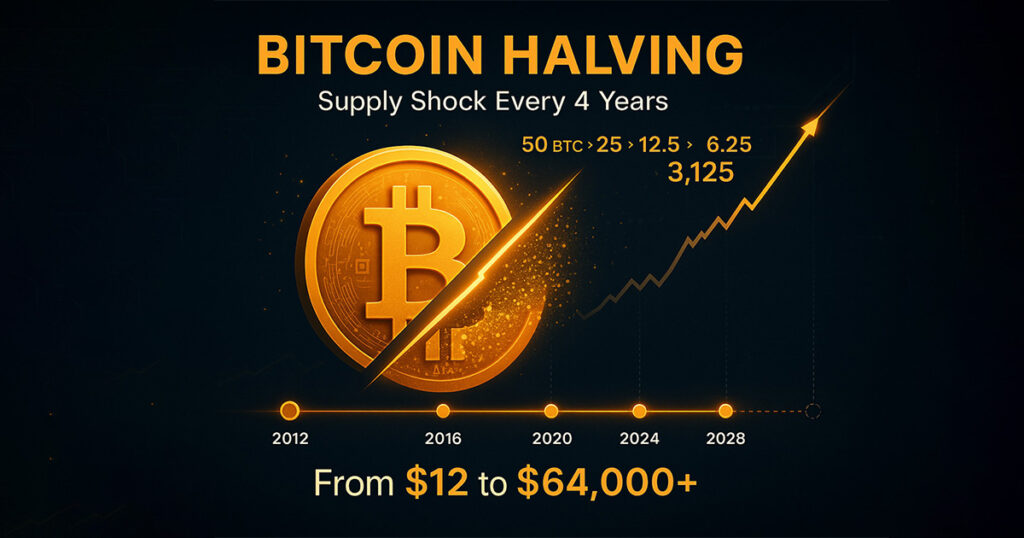
Bitcoin halving is a pre-programmed event built into Bitcoin’s code that cuts the reward for mining new blocks in half. This mechanism occurs approximately every four years, or more precisely, every 210,000 blocks mined. When miners successfully validate transactions and add a new block to the blockchain, they receive newly created bitcoins as a reward—but this reward decreases by 50% at each halving.
The genius of this system lies in its predictability and its purpose: controlling Bitcoin’s inflation rate while ensuring a maximum supply of only 21 million coins. Unlike traditional currencies that central banks can print at will, Bitcoin’s supply follows a mathematical formula that no single entity can change.
The Technical Foundation of Halving Events
How the Bitcoin Protocol Works
At its core, Bitcoin operates on a proof-of-work consensus mechanism where miners compete to solve complex mathematical puzzles. The first miner to solve the puzzle gets to add the next block to the blockchain and receives the block reward. This process happens roughly every 10 minutes, maintaining a steady and predictable rate of new bitcoin creation.
The halving mechanism is hardcoded into Bitcoin’s protocol, making it an immutable feature of the network. This transparency allows everyone to know exactly when halvings will occur and how they’ll affect the supply of new bitcoins entering circulation.
Satoshi Nakamoto’s Vision for Scarcity
Bitcoin’s mysterious creator, Satoshi Nakamoto, designed the halving mechanism to mimic the extraction of precious metals like gold. Just as gold becomes harder to mine over time, Bitcoin becomes increasingly scarce through successive halvings. This built-in deflationary mechanism starkly contrasts traditional fiat currencies, which typically lose value over time due to inflation.
This design’s brilliance ensures that Bitcoin’s monetary policy remains predictable and immune to political interference or economic pressures that affect traditional currencies.
Historical Bitcoin Halving Timeline
The journey of Bitcoin halvings tells a compelling story of growth, adoption, and market maturation. Each event has brought unique challenges and opportunities, shaping our current cryptocurrency landscape.
| Halving Event | Date | Block Height | Reward Change | Price at Halving | Peak Price | % Gain |
|---|---|---|---|---|---|---|
| First Halving | Nov 28, 2012 | 210,000 | 50→25 BTC | $12 | $1,075 | 8,858% |
| Second Halving | Jul 9, 2016 | 420,000 | 25→12.5 BTC | $650 | $19,000 | 2,823% |
| Third Halving | May 11, 2020 | 630,000 | 12.5→6.25 BTC | $8,572 | $69,000 | 705% |
| Fourth Halving | Apr 20, 2024 | 840,000 | 6.25→3.125 BTC | $64,000 | TBD | 31%* |
*As of July 2025
First Halving (2012): The Beginning
The inaugural Bitcoin halving occurred on November 28, 2012, when Bitcoin was still largely unknown outside tech circles. The block reward dropped from 50 BTC to 25 BTC, marking the first test of Nakamoto’s economic theory. At the time, Bitcoin traded around $12, and few could have predicted what would follow.
Within a year, Bitcoin’s price skyrocketed to over $1,000, representing an astounding 8,858% increase. This dramatic price movement validated the halving mechanism’s potential impact and attracted a new wave of investors and speculators to the cryptocurrency space.
Second Halving (2016): Growing Awareness
By July 9, 2016, Bitcoin had gained significant traction, trading around $650 when the second halving reduced rewards from 25 BTC to 12.5 BTC. The cryptocurrency community watched closely, armed with data from the first halving but uncertain if history would repeat.
The results were impressive, though more modest than the first cycle. Bitcoin reached $2,560 within 12 months—a 294% increase—before ultimately peaking near $19,000 in December 2017. This halving coincided with the ICO boom, bringing unprecedented mainstream attention to cryptocurrencies.
Third Halving (2020): Institutional Interest
The third halving on May 11, 2020, occurred during extraordinary circumstances. The COVID-19 pandemic had initially crashed Bitcoin to around $5,000, but it recovered to approximately $8,572 by the halving date. This event reduced rewards from 12.5 BTC to 6.25 BTC.
Despite global economic uncertainty, Bitcoin demonstrated remarkable resilience. Within 12 months, it reached $55,847—a 540% increase—and eventually peaked around $69,000 in November 2021. This cycle saw unprecedented institutional adoption, with companies like MicroStrategy and Tesla adding Bitcoin to their balance sheets.
Fourth Halving (2024): A New Era
The most recent halving on April 20, 2024, reduced rewards from 6.25 BTC to 3.125 BTC. This event occurred in a fundamentally different market environment, with Bitcoin ETFs approved and institutional infrastructure firmly established. Bitcoin traded around $64,000 at the halving, and as of mid-2025, it has shown a more modest 31% increase.
How Bitcoin Halving Affects Supply and Demand
The Economics of Scarcity
Bitcoin halving creates what economists call a “supply shock.” By instantly cutting the production of new bitcoins in half, the mechanism reduces selling pressure from miners who often need to sell their rewards to cover operational costs. Basic economic principles suggest prices should rise when demand remains constant or increases while supply decreases.
Mining Rewards Reduction
Before the 2024 halving, approximately 900 new bitcoins entered circulation daily. Post-halving, this number dropped to just 450 bitcoins per day. This dramatic reduction means that even if demand remains flat, the available supply for purchase decreases significantly, creating upward price pressure.
Impact on Bitcoin Inflation Rate
Each halving dramatically reduces Bitcoin’s inflation rate. After the 2020 halving, Bitcoin’s annual inflation dropped to approximately 1.8%, lower than most developed nations’ target inflation rates. The 2024 halving pushed this even lower, making Bitcoin increasingly deflationary compared to traditional currencies.
Price Performance Analysis After Each Halving
Diminishing Returns Pattern
While each halving has preceded significant price appreciation, the data reveals a clear pattern of diminishing returns:
- First halving: 8,858% gain within 12 months
- Second halving: 294% gain within 12 months
- Third halving: 540% gain within 12 months
- Fourth halving: 31% gain (as of mid-2025)
This pattern suggests that as Bitcoin’s market capitalization grows and the asset matures, the percentage gains from each halving become more modest, though still potentially significant in absolute terms.

Market Cycle Observations
Historical data shows that Bitcoin typically experiences its peak price 12-18 months after each halving. This delay reflects the time needed for reduced supply to impact market dynamics and for investor awareness to build. Understanding these cycles has become crucial for investors to time their entry and exit strategies.

| Metric | 1st Halving | 2nd Halving | 3rd Halving | 4th Halving |
|---|---|---|---|---|
| 12-Month Gain | 8,858% | 294% | 540% | 31%* |
| Time to Peak | 12 months | 17 months | 18 months | TBD |
| Peak Multiplier | 89.6x | 29.2x | 8.0x | TBD |
| Market Maturity | Nascent | Growing | Institutional | Mature |
*Ongoing as of July 2025
Mining Economics and Network Security
Miner Profitability Challenges
Each halving creates immediate pressure on Bitcoin miners, who see their primary revenue source cut in half overnight. This forces miners to optimize operations, upgrade to more efficient hardware, or cease operations if they can’t remain profitable. The 2024 halving particularly challenged miners operating on thin margins, leading to industry consolidation.
| Year | Block Reward | Daily BTC Created | Annual Inflation Rate | BTC Price Needed for Profitability* |
|---|---|---|---|---|
| 2009-2012 | 50 BTC | 7,200 | 25%+ | <$10 |
| 2012-2016 | 25 BTC | 3,600 | 12.5% | $100-200 |
| 2016-2020 | 12.5 BTC | 1,800 | 4.2% | $3,000-5,000 |
| 2020-2024 | 6.25 BTC | 900 | 1.8% | $15,000-20,000 |
| 2024-2028 | 3.125 BTC | 450 | 0.9% | $30,000-40,000 |
*Estimated based on average mining costs
Hash Rate Adjustments
Despite concerns about mining centralization, Bitcoin’s network has demonstrated remarkable resilience through multiple halvings. The network’s difficulty adjustment mechanism ensures that blocks continue to be produced every 10 minutes, regardless of how many miners participate.
Network Resilience
Historical data shows that while some miners exit after halvings, the network’s security remains robust. The remaining miners benefit from reduced competition, and Bitcoin’s rising price often compensates for the reduced block rewards, maintaining network security.
Institutional Adoption and Market Evolution
ETF Impact on Halving Dynamics
The approval of Bitcoin ETFs in 2024 fundamentally altered traditional halving dynamics. These investment vehicles have absorbed over 1.13 million BTC, creating unprecedented institutional demand. Unlike previous cycles dominated by retail investors, institutional players now compete for the limited supply, potentially accelerating price movements.
Government Strategic Reserves
Government discussions of Bitcoin strategic reserves, including proposals in the United States and Brazil, represent a paradigm shift. Government purchases could create sustained demand pressure that amplifies halving effects, fundamentally altering market dynamics for future cycles.
Investment Strategies Around Halving Events
Dollar-Cost Averaging Approach
Many successful Bitcoin investors employ dollar-cost averaging (DCA) strategies around halving events. This approach involves making regular purchases regardless of price, capitalizing on long-term appreciation while mitigating short-term volatility risks.
Timing Considerations
Historical patterns suggest accumulating Bitcoin 12-18 months before halvings, when prices often consolidate. However, attempting to time perfectly the market remains challenging, and many investors prefer consistent accumulation strategies over trying to predict exact tops and bottoms.
Risk Management
The cryptocurrency market’s inherent volatility requires careful risk management. Diversification across asset classes, appropriate position sizing based on risk tolerance, and maintaining emergency reserves remain essential practices, regardless of halving cycles.
| Strategy | Start Time | Investment Period | Historical Result | Risk Level |
|---|---|---|---|---|
| Pre-Halving DCA | 18 months before | 18 months | Best returns | Medium |
| Post-Halving DCA | At halving | 12 months | Good returns | High |
| Continuous DCA | Anytime | Ongoing | Moderate returns | Low |
| Lump Sum at Halving | At halving | One-time | Variable | Very High |
The Next Bitcoin Halving: 2028 Predictions
Expected Date and Block Rewards
The next Bitcoin halving is projected for March or April 2028, when block rewards will decrease from 3.125 BTC to 1.5625 BTC. This fifth halving will further reduce Bitcoin’s inflation rate and continue the march toward the 21 million coin limit.
Market Projections
By 2028, Bitcoin will likely see further institutional adoption, potentially including central bank holdings and deeper integration with traditional financial systems. The reduced daily issuance of approximately 225 BTC will create even greater scarcity pressure than previous halvings.
Regulatory and Macroeconomic Factors
Government Adoption Trends
The regulatory landscape continues evolving favorably, with major economies providing clearer frameworks for cryptocurrency operations. This regulatory clarity and potential government Bitcoin purchases could fundamentally alter demand dynamics around future halvings.
Monetary Policy Interactions
Bitcoin’s performance around halvings shows correlation with broader monetary policy cycles. Periods of economic expansion generally favor Bitcoin, while tightening cycles create headwinds. These macroeconomic trends will likely influence future halvings.
Common Misconceptions About Bitcoin Halving
Many newcomers believe halving events guarantee immediate price increases, but historical data shows that significant price movements often take months to materialize. Additionally, the pattern of diminishing returns suggests that expecting similar percentage gains to early halvings may lead to disappointment.
Another misconception is that halvings surprise the market. In reality, these events are entirely predictable and likely already partially priced in by informed market participants.
How to Prepare for Future Halvings
Successful preparation involves understanding both the opportunities and risks that halvings present. Investors should:
- Educate themselves on Bitcoin’s fundamentals
- Develop a long-term investment strategy
- Avoid emotional decision-making during volatile periods
- Consider dollar-cost averaging approaches
- Maintain appropriate risk management
The Long-Term Impact on Bitcoin’s Value
As Bitcoin approaches its 21 million coin limit, each halving brings the network closer to its final form as a fully mature, deflationary digital asset. While percentage gains may diminish, the absolute value potential remains significant as adoption increases and supply becomes increasingly constrained.
Frequently Asked Questions
What exactly happens during a Bitcoin halving?
During a Bitcoin halving, miners’ reward for adding new blocks to the blockchain is cut in half. This programmed event occurs every 210,000 blocks, reducing the rate at which new bitcoins enter circulation.
When is the next Bitcoin halving?
The next Bitcoin halving is expected to occur in March or April 2028, when the block reward will decrease from 3.125 BTC to 1.5625 BTC.
Do Bitcoin halvings guarantee price increases?
While historical data shows price appreciation following each halving, past performance doesn’t guarantee future results. Many factors beyond halvings influence Bitcoin’s price, including adoption rates, regulatory changes, and macroeconomic conditions.
How many Bitcoin halvings will there be?
There will be approximately 32 halvings in total, with the last one expected around 2140. After this final halving, miners will rely solely on transaction fees for revenue.
Why does Bitcoin have halvings?
Bitcoin halvings control the cryptocurrency’s inflation rate and ensure scarcity. This mechanism was designed to create a deflationary digital currency with a predictable, limited supply of 21 million coins.
Conclusion
Bitcoin halving events remain fundamental drivers of the cryptocurrency’s economic model, creating predictable supply shocks that have historically preceded significant price movements. While the pattern of diminishing returns suggests more modest percentage gains in future cycles, the combination of increasing adoption and decreasing supply continues to support a long-term bullish thesis.
As we look toward the 2028 halving and beyond, the cryptocurrency landscape will likely be dramatically different from today. Institutional adoption, regulatory clarity, and potential government participation may create new dynamics that reshape how halvings impact markets. For investors and enthusiasts alike, understanding these cycles remains crucial for navigating the evolving world of digital assets.
The journey from Bitcoin’s first halving at $12 to today’s five-figure valuations demonstrates the profound impact these events can have. As Bitcoin continues evolving from experimental digital currency to mature financial asset, halvings will remain key milestones marking its progress toward becoming a fully realized store of value for the digital age.
Ready to prepare for the next Bitcoin halving? Visit Cash2Bitcoin to easily purchase Bitcoin through our convenient ATM locations across the United States or securely online. Start your cryptocurrency journey today with trusted, user-friendly services designed for beginners and experienced investors.

